Recycling and Sustainability — Garden Maintenance Barkingside
 Garden Maintenance Barkingside is committed to creating an eco-friendly waste disposal area and a genuinely sustainable rubbish gardening area across every site we manage. Our approach balances practical on-site waste separation with city and borough systems, so each garden, verge and communal green space contributes to a circular, low-carbon neighbourhood in Redbridge and surrounding London boroughs. We adopt best practices inspired by the borough's approach to waste separation—paper and card, mixed recycling, food waste and a separate garden waste stream—so our teams sort materials at source and minimise contamination.
Our policies for Barkingside garden services centre on reducing landfill and diverting green and reusable materials to the highest value use. That means turning prunings and lawn cuttings into mulch, diverting timber for chipping and reuse, and ensuring soil and inert material are treated sensitively. We work with customers to set aside a clearly marked eco-friendly disposal area on site where segregated materials are stored temporarily in labelled containers, helping crews maintain consistent separation before transfer.
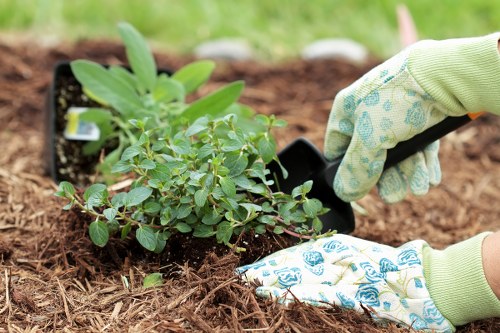 We also align with local municipal facilities and transfer points. To maximise resource recovery we use nearby civic amenity sites and municipal transfer stations in Ilford, Barking and neighbouring boroughs for green waste and recyclables. These transfer hubs and composting facilities are central to our logistics planning, allowing us to send different streams—garden waste, wood, metals, bulky items and mixed recyclables—for specialist processing rather than general landfill.
Practical steps: on-site segregation, partnerships and targets
Our sustainable garden-care in Barkingside is supported by practical measures: clearly labelled bins, portable sacks for uncontaminated green waste, and a small on-site staging area for reusable items. We emphasise staff training so that crews working on garden maintenance Barkingside jobs consistently follow separation rules. We do not accept hazardous household waste on site, and we work with customers to identify materials better handled by municipal hazardous waste streams.
 We have formal partnerships with local charities and community reuse organisations to extend the life of items collected during garden clearances. Rather than automatic disposal, usable furniture, planters, tools and quality timber are offered to community projects, repair workshops and local reuse charities. These partnerships increase reuse and support community green initiatives while reducing waste handling costs and carbon emissions.
Our fleet strategy supports sustainability too: a growing fleet of low-carbon vans and small electric vehicles is deployed for Barkingside garden maintenance tasks. These low-emission vehicles, alongside route optimisation and grouped site visits, cut operational emissions. We also use hybrid and Euro 6-compliant vehicles where electric options are not yet feasible, and all vehicles carry secure, labelled containers to avoid cross-contamination of waste streams during transit.
Local recycling activities, transfer stations and what we accept
On a typical Barkingside assignment, common recycling activities include: source-separated green waste collection for composting, segregating clean wood and timber for chipping, preparing bulky garden furniture for donation, and capturing metals and plastics for municipal recycling. Our teams reflect borough guidance—food waste kept separate where present, paper and card bundled for recycling, and domestic refuse kept apart from garden materials. We implement these steps to support the wider Redbridge objective of higher local recycling rates.
 We publish a clear recycling percentage target for our operations: our goal is to achieve at least 70% diversion of garden and related waste from landfill within two years on all managed sites in Barkingside. This target covers green waste, timber, metals, recyclables and items placed for reuse through charity partners. Progress is monitored by weight-based reporting at transfer stations and by logging donations and reuse outcomes, so clients and community partners can see measurable improvements.
 To make this real we use a small set of consistent practices: document every load, choose the right municipal transfer station or composting partner, and prioritise repair and reuse through charity partnerships. Our Barkingside garden maintenance teams provide weekly records of materials diverted, and we continually refine routes and staging areas to reduce double-handling. By combining low-carbon vans, local transfer station use and strong charity partnerships, we create a practical, scalable model for sustainable garden maintenance across the borough.
In short, whether described as garden maintenance Barkingside, Barkingside garden maintenance or our sustainable rubbish gardening area service, the emphasis is the same: reduce, reuse, recycle and cut carbon. Our on-site eco-friendly waste disposal areas, close coordination with transfer stations and composting sites, charity reuse schemes and low-emission fleet investments are all parts of a single plan to deliver greener gardens and cleaner streets.
Key elements at a glance:
- Recycling target: 70% diversion of garden-related waste from landfill within two years.
- Local transfer stations: use of municipal hubs, composting facilities and civic amenity sites in Ilford, Barking and neighbouring boroughs for specialist processing.
- Charity partnerships: reuse and donation pathways for serviceable items, planters and clean timber.
- Low-carbon fleet: electric, hybrid and Euro 6 vehicles to reduce site-to-site emissions.
Our work in Garden Maintenance Barkingside aims to show that professional gardening services can be part of the climate solution—delivering attractive, healthy green spaces while cutting waste and emissions through practical, local action.